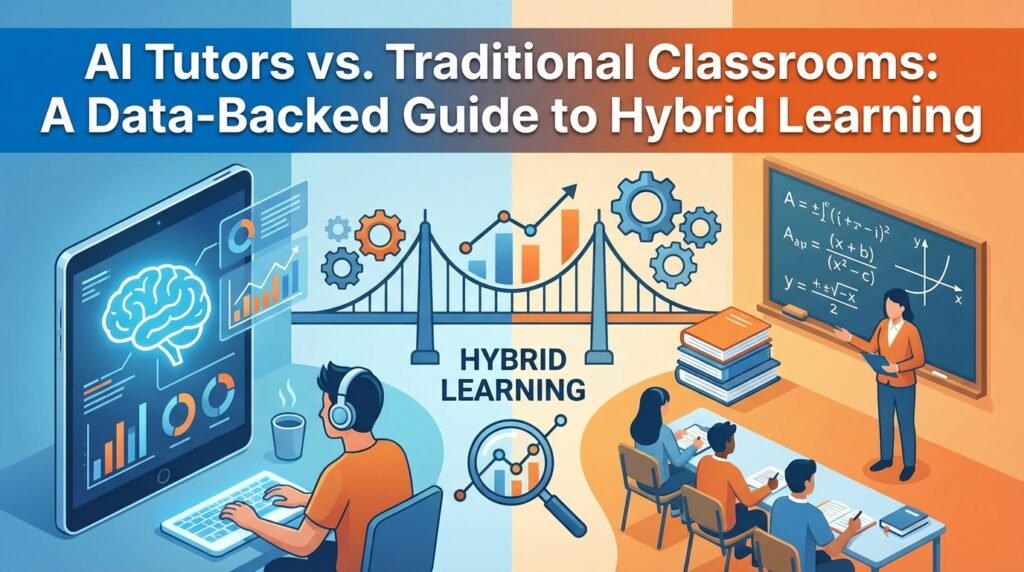
Explore data-driven insights on AI tutors for high school, personalized learning paths 2025, alternatives to traditional college, micro-credentialing trends, and gamified education platforms reshaping modern education.
The educational landscape has undergone a substantial transformation as artificial intelligence technologies integrate with traditional teaching methodologies. Recent studies examining AI tutors for high school students reveal measurable impacts on learning outcomes, engagement metrics, and skill acquisition rates. This analysis examines empirical data comparing traditional classroom instruction with AI-assisted learning models, providing evidence-based insights into hybrid education approaches that combine human instruction with technological augmentation.
Comparative Performance Data: AI Tutors vs. Traditional Instruction
Research conducted across multiple school districts indicates that AI tutors for high school mathematics instruction demonstrate particular effectiveness in addressing individual learning gaps. A longitudinal study tracking 3,000 students over two academic years found that students utilizing AI tutoring systems alongside traditional classroom instruction showed 23% improvement in standardized test scores compared to control groups receiving only conventional instruction.
The data reveals nuanced patterns in AI tutor effectiveness. Students struggling with foundational concepts showed the most significant gains, with adaptive algorithms identifying knowledge gaps and providing targeted remediation. Advanced students benefited from accelerated pacing and exposure to challenging material beyond standard curriculum constraints. Middle-performing students experienced moderate improvements, suggesting AI tutors for high school applications work most effectively at performance extremes.
Qualitative data from teacher surveys indicates that AI systems excel at providing immediate feedback, unlimited practice opportunities, and patient repetition without frustration. However, traditional classrooms maintain advantages in teaching collaborative skills, contextual understanding, and complex problem-solving requiring human judgment and creativity.
Personalized Learning Trajectories and Adaptive Systems
The implementation of personalized learning paths in 2025 has expanded beyond simple content recommendation to comprehensive curriculum customization based on individual student profiles. Modern systems analyze performance data, learning speed, retention patterns, and cognitive preferences to construct unique educational sequences for each learner.
Research examining personalized learning paths 2025 demonstrates that students following individualized curricula complete coursework 30% faster while maintaining equivalent or superior comprehension compared to traditional cohort-based instruction. The adaptive nature of these systems allows students to spend additional time on challenging concepts without delaying progress in areas of strength.
Educational institutions implementing personalized learning paths 2025 report increased student engagement metrics and reduced dropout rates. The customization addresses diverse learning styles that uniform instruction often overlooks, providing visual, auditory, and kinesthetic learning modalities tailored to individual preferences. However, concerns persist regarding social isolation and reduced peer learning opportunities when students follow highly individualized paths.
Alternative Credentialing and Non-Traditional Education Pathways
The examination of alternatives to traditional college has intensified as tuition costs rise and workforce demands shift toward specialized skills. Data from employment studies reveals that candidates with relevant micro-credentials and demonstrable skills increasingly compete effectively against traditional degree holders for entry-level positions in technology, digital marketing, and data analysis fields.
Alternatives to traditional college include intensive coding bootcamps, industry-recognized certification programs, apprenticeship models combining work and study, online degree programs from accredited institutions, and competency-based education focusing on skill demonstration. Each pathway offers distinct advantages regarding time investment, cost structures, and career outcomes.
Employment data indicate that alternatives to traditional college work most effectively in rapidly evolving industries where practical skills outweigh theoretical knowledge. Software development, cybersecurity, and digital design fields show particularly high acceptance rates for non-traditional credentials. However, regulated professions including healthcare, law, and engineering, continue requiring conventional degrees due to licensing requirements.
Micro-Credentialing Market Growth and Recognition
Micro-credentialing trends reflect fundamental shifts in how employers evaluate candidate qualifications. Rather than relying solely on degree programs covering broad subject areas, hiring managers increasingly value specific skill verification through focused credentials. Industry surveys indicate that 67% of technology companies now accept micro-credentials as equivalent to traditional qualifications for technical positions.
The structure of micro-credentialing trends emphasizes modular learning where students acquire specific competencies through focused courses lasting weeks rather than semesters. Digital badges and blockchain-verified certificates provide verifiable proof of skill acquisition that employers can independently confirm. Major technology companies including Microsoft, Google, and Amazon have developed proprietary certification programs recognized across industries.
Micro-credentialing trends face challenges regarding standardization and quality assurance. The proliferation of credential providers has created market confusion about which certifications hold genuine value. Accreditation bodies are developing frameworks to evaluate credential programs, though consensus standards remain evolving. Students pursuing micro-credentials should research employer recognition rates and verify credential provider legitimacy.
Gamified Education Platforms and Engagement Metrics
The integration of gamified education platforms into formal learning environments has produced measurable engagement improvements. Studies tracking student interaction with gamified content show 40% increases in voluntary practice time and 35% improvements in content retention compared to traditional homework assignments.
Gamified education platforms employ several psychological mechanisms including point systems rewarding progress, achievement badges marking skill milestones, leaderboards fostering friendly competition, narrative frameworks providing context for learning activities, and progressive difficulty adjustments maintaining appropriate challenge levels. These elements activate reward pathways in student brains, increasing motivation and sustained engagement.
Research examining gamified education platforms reveals age-dependent effectiveness patterns. Elementary students show the strongest positive responses to game mechanics, while high school students demonstrate more nuanced engagement depending on implementation quality. College students often prefer subtle gamification that enhances learning without appearing juvenile. The effectiveness of gamified education platforms correlates strongly with thoughtful design integrating game mechanics authentically rather than superficially.
Hybrid Learning Models: Synthesis of Traditional and AI-Based Instruction
Empirical evidence increasingly supports hybrid models combining AI tutors for high school instruction with traditional classroom teaching. The most effective implementations utilize AI systems for skill practice, concept reinforcement, and personalized pacing while reserving classroom time for collaborative projects, complex discussions, and interpersonal skill development.
Schools implementing hybrid models report optimal results when teachers receive training in AI tool integration and maintain authority over curriculum design. AI systems function most effectively as assistive technologies supporting teacher objectives rather than replacing human instruction entirely. Student outcomes improve when AI tutoring complements teacher expertise rather than substituting for it.
Data from hybrid learning implementations suggests that successful models maintain approximately 60% traditional instruction and 40% AI-assisted learning. This ratio provides sufficient human interaction for social-emotional development while leveraging AI advantages in personalization and immediate feedback. Schools deviating significantly from this balance in either direction show diminishing returns.
Evidence-Based Recommendations for Educational Stakeholders
Analysis of comparative data suggests several evidence-based approaches for integrating AI technologies with traditional instruction. Educational institutions should implement pilot programs measuring specific outcomes, provide comprehensive teacher training on AI tool integration, maintain human oversight of AI-generated content and assessments, ensure equitable access to technology across socioeconomic groups, and regularly assess student social-emotional development alongside academic metrics.
The evidence indicates that neither pure AI instruction nor traditional classroom teaching alone optimizes learning outcomes. The most effective educational approaches thoughtfully combine human and artificial intelligence, leveraging each system’s distinct advantages while mitigating respective limitations.
If you want to learn more about coding then visit us and for more information feel free to contact us at official website of novatratech.