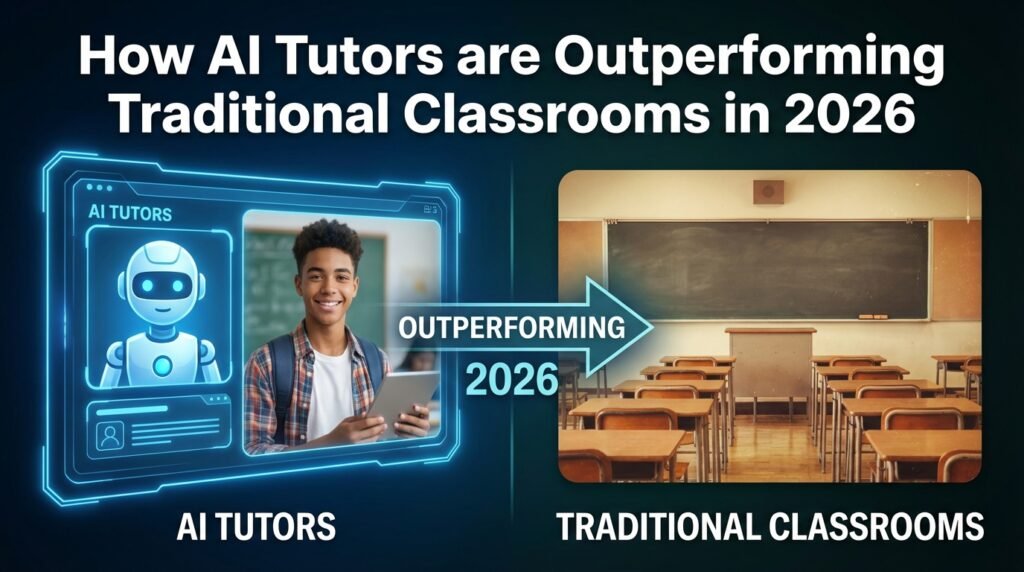
Discover how AI study tools for students are transforming education in 2026. Analysis of AI tutors’ performance, free online degree programs 2026, scholarships for AI research, and the future of EdTech compared to traditional classrooms.
The educational landscape has undergone a fundamental transformation as artificial intelligence tutoring systems demonstrate measurable advantages over conventional classroom instruction. Recent studies indicate that students using AI study tools for students show performance improvements ranging from 15 to 35 percent across various subjects, raising questions about the future structure of education.
Personalized Learning at Scale
AI tutoring systems excel at providing individualized instruction that adapts to each student’s learning pace and style. Unlike traditional classrooms where teachers must address 20 to 30 students simultaneously, AI study tools for students offer one-on-one attention continuously. These systems analyze response patterns, identify knowledge gaps, and adjust difficulty levels in real-time.
Research conducted throughout 2025 demonstrates that adaptive learning algorithms can identify student misconceptions within three to five practice problems, compared to weeks or months in traditional settings. This rapid identification enables immediate intervention, preventing the accumulation of foundational gaps that often hinder long-term academic progress.
The effectiveness of AI study tools for students extends beyond basic subjects. Advanced systems now provide tutoring in complex disciplines, including organic chemistry, differential equations, and computer science. The ability to break down intricate concepts into personalized learning pathways has shown particular benefit for students who struggle in traditional lecture-based environments.
Integration with Accessible Education Programs
The proliferation of free online degree programs in 2026 has created new opportunities for students worldwide. Major universities and education platforms now offer complete degree programs without tuition costs, supported by AI tutoring infrastructure that replaces traditional teaching assistants and supplemental instruction.
Free online degree programs 2026 statistics show enrollment numbers exceeding three million students globally, with completion rates improved by 40 percent compared to previous online education models. This improvement correlates directly with the integration of AI tutoring systems that provide consistent support throughout degree programs.
The combination of free online degree programs 2026 and AI tutoring has democratized access to higher education. Students in regions with limited educational infrastructure now access university-level instruction comparable to elite institutions. Geographic and economic barriers that historically limited educational opportunity have diminished significantly through these technological advances.
Financial Support and Research Opportunities
Scholarships for AI research have expanded substantially as institutions recognize the field’s importance. Universities and technology organizations allocated over $500 million to scholarships for AI research in 2025, supporting both undergraduate and graduate students. These funding opportunities specifically target students developing educational AI systems and studying AI’s impact on learning outcomes.
Many scholarships for AI research now include mentorship components where students work directly with AI education platforms. This practical experience creates a feedback loop where scholarship recipients contribute to improving the very systems supporting their education. The model represents a shift from traditional scholarship structures focused solely on tuition assistance.
The availability of scholarships for AI research has encouraged students from diverse backgrounds to enter both AI development and educational technology fields. This diversity strengthens research perspectives on how different populations interact with AI tutoring systems, leading to more inclusive educational tools.
Language Learning and Assessment Evolution
The comparison between IELTS vs Duolingo English Test exemplifies broader shifts in educational assessment. Traditional standardized tests like IELTS require in-person proctoring and standardized conditions, while the Duolingo English Test utilizes AI proctoring and adaptive questioning that adjusts to test-taker ability levels.
The IELTS vs Duolingo English Test debate extends beyond convenience to fundamental questions about assessment validity. AI-powered tests can measure language proficiency through thousands of micro-interactions, building comprehensive ability profiles. Traditional tests like IELTS rely on performance during a single testing session, which may not capture full proficiency.
Acceptance of the Duolingo English Test by over 4,000 institutions by late 2025 indicates growing comfort with AI-based assessment. The IELTS vs Duolingo English Test discussion has shifted from questioning legitimacy to examining which format better serves specific educational contexts. Both assessments maintain validity, with selection depending on institutional requirements and test-taker circumstances.
Future of EdTech and Traditional Education
The future of EdTech involves deeper integration with rather than complete replacement of traditional education. Hybrid models combining AI tutoring with human instruction show the strongest learning outcomes. Teachers in these environments transition from content delivery to mentorship roles, addressing socio-emotional development and complex critical thinking that AI systems handle less effectively.
The future of EdTech development focuses on collaboration tools that enable peer learning alongside AI tutoring. Social learning components address criticisms that AI systems isolate students. Modern platforms incorporate group problem-solving, peer review, and collaborative projects while maintaining personalized learning pathways.
Concerns about the future of EdTech include questions about data privacy, algorithmic bias, and the preservation of human connection in education. Educational institutions implementing AI systems must address these considerations through transparent data policies and regular evaluation of AI recommendations for bias across demographic groups.
Performance Data and Measured Outcomes
Longitudinal studies tracking students using AI study tools for students reveal sustained performance improvements. Students using AI tutoring for mathematics showed test score improvements averaging 22 percent after one semester, with gains maintained through subsequent years. Reading comprehension and writing skills demonstrated similar patterns, with improvements ranging from 18 to 28 percent.
Comparative studies between AI-tutored students and those in traditional classrooms control for variables including prior achievement, socioeconomic status, and school quality. Results consistently favor AI-assisted learning across these demographic categories, though the magnitude of benefit varies. Students with prior learning difficulties show the largest gains, suggesting AI tutoring effectively addresses individual needs.
The future of EdTech research priorities includes understanding long-term retention and transfer of knowledge gained through AI tutoring. Early data indicate that students retain information learned through adaptive systems at rates comparable to or exceeding traditional instruction, though comprehensive multi-year studies remain ongoing.
Implementation Challenges and Considerations
Despite demonstrated benefits, AI tutoring implementation faces obstacles. Infrastructure requirements, including reliable internet access and computing devices, remain barriers in many regions. Free online degree programs 2026 initiatives often include device lending programs, though gaps persist in rural and economically disadvantaged areas.
Teacher training represents another implementation challenge. Educators require professional development to effectively integrate AI study tools for students into curricula. The transition from traditional instruction to facilitation roles necessitates new pedagogical approaches and comfort with technology systems.
The evolution of education through AI tutoring systems continues to reshape how students learn and how institutions deliver instruction. As these technologies mature and accessibility improves, the gap between traditional and AI-enhanced education will likely narrow through hybrid approaches that combine technological efficiency with essential human elements of teaching.
Learn more about AI tutors vs traditional classrooms. And use of cursor ai in study.For more study related queries you can cotact us through our official platform Novatratech academy.